Products
AR Film
Anti-Reflection (AR) Film — Moth-Eye Nanostructure That Removes Reflection
GreenBworld anti-reflection film is produced by imprinting a moth-eye nanostructure directly onto the film surface using roll-to-roll nanoimprint lithography. Instead of relying on multilayer vacuum deposition, the structure itself creates a graded refractive index, delivering stable low-reflectance performance across a wide spectral band and a wide range of incident angles.
How the Moth-Eye Structure Works
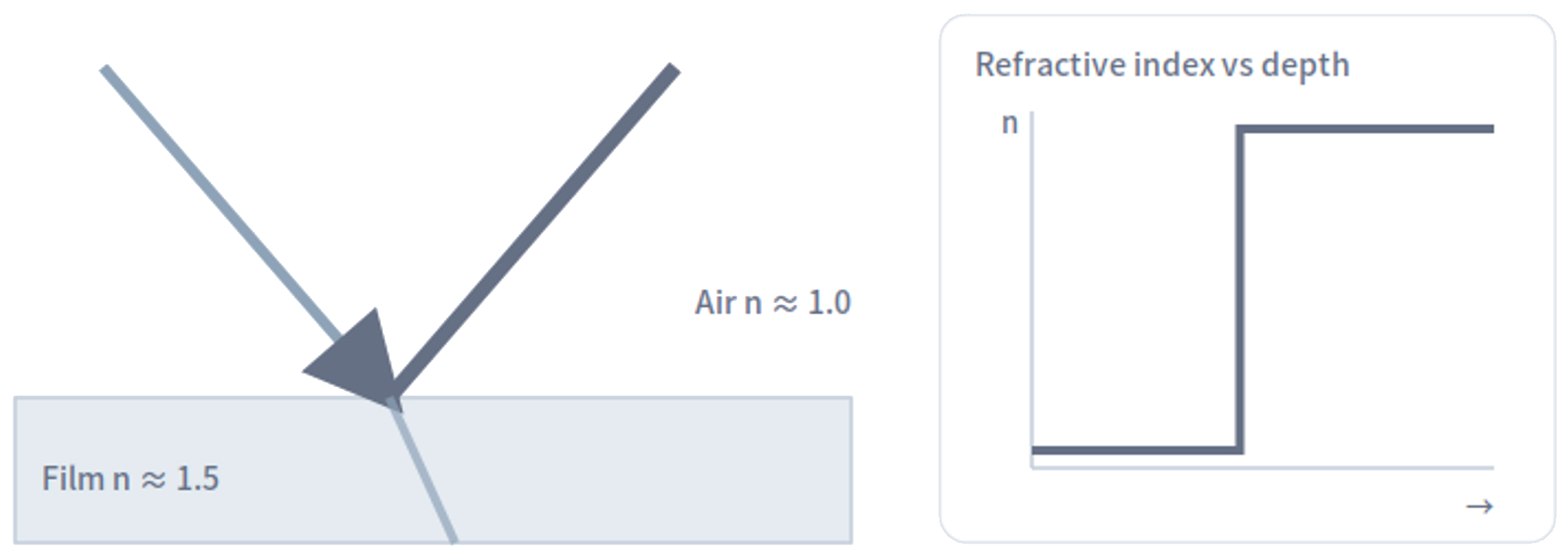
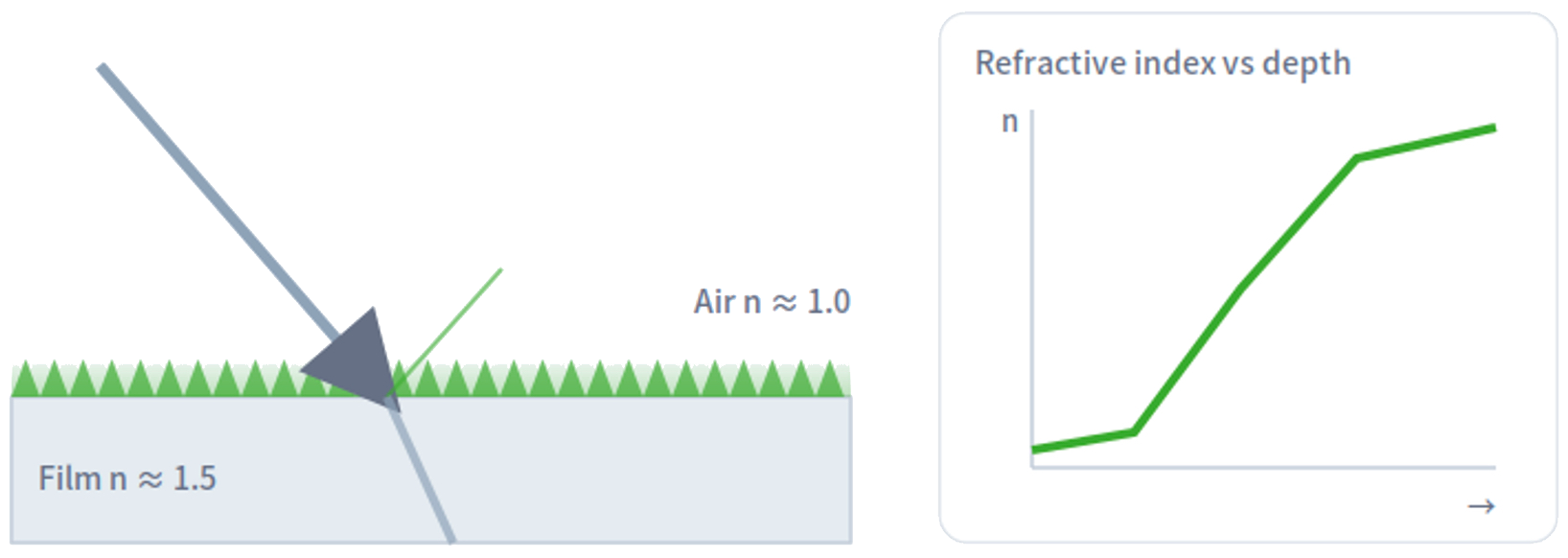
Light reflects wherever the refractive index changes abruptly. A moth-eye surface carries dense sub-wavelength conical protrusions, so the refractive index shifts gradually from air to film rather than in a single step. With no distinct boundary, there is no clear surface from which light can reflect. Unlike deposited AR coatings, which are optimised for a narrow wavelength band, the structural approach maintains uniformly low reflectance across the visible spectrum.
Key Benefits
Broadband low reflectance
minimal colour shift in the reflected image
Wide-angle performance
reflectance rises only slightly at oblique angles
Structural approach
better suited to continuous R2R production than multilayer vacuum deposition
Higher contrast
reduced surface reflection improves black level and legibility
Film Structure
| Layer | Composition | Function |
|---|---|---|
| Layer 3 (top) | Low-refractive-index hollow silica topcoat | Further lowers index to minimise residual reflection |
| Layer 2 | High-refractive-index NIL moth-eye layer | Forms the graded refractive index profile |
| Layer 1 (base) | PET substrate | Mechanical support and processability |
FAQ
How does this differ from deposited AR coating?
Deposited AR requires stacking thin films in a vacuum chamber, which carries high equipment cost and long cycle times. A structural moth-eye AR is imprinted from a nano mould, enabling continuous roll-to-roll production with lower wavelength and angle dependence.

What about durability?
A protective low-refractive-index topcoat is applied over the nanostructure, and abrasion resistance can be tuned to the operating environment.
Can AG and AR be combined?
Yes. Surface scattering (AG) and low reflectance (AR) can be combined in a single design depending on the application.
Moth-Eye Nanostructure — Removing the Surface to Reflect From
Flat conventional surface
Strong reflection
The refractive index changes abruptly at the boundary, so light reflects strongly there.
Moth-eye nanostructured surface
Minimal reflection
Sub-wavelength cones grade the refractive index, so there is no distinct boundary left to reflect from.
Conceptual diagram | Actual protrusions are smaller than visible wavelengths.